

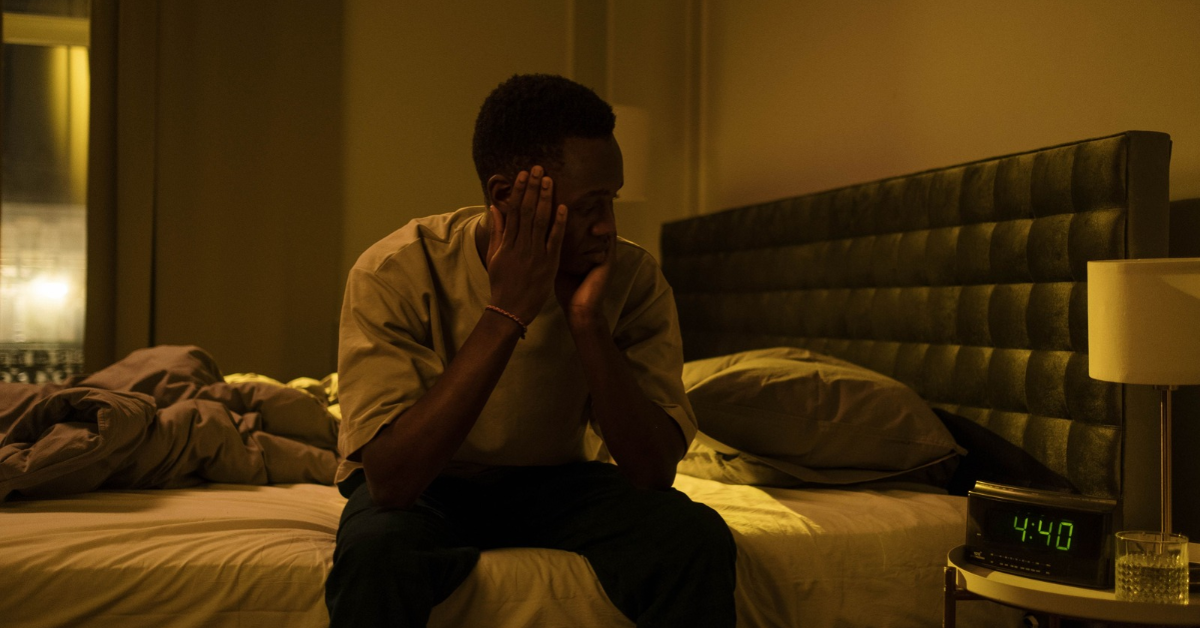
You’re doing the work. Exercises every day. Tracking water intake. You even kept that one tiny habit going.
And six weeks in, it still feels… stuck.
Meanwhile it’s 2am and you’re wide awake, running through tomorrow’s meetings, the appointment you forgot to book, and whether that twinge on the stairs means you just set yourself back.
Here’s the part nobody puts on the exercise sheet. A lot of the actual repair happens while you’re asleep and not stressed. And when you’re injured, good sleep and low stress are hard to come by.
Your body does its best repair work off the clock
Sleep isn’t just downtime for your body, it’s when a lot of the repair and rebuilding gets done. In one study, five nights of four hours of sleep cut muscle protein synthesis (the process your body uses to repair and rebuild muscle) by about 19% (Saner et al., 2020). Less than a week! Most people in pain are short on sleep for a lot longer than that.
Stress pulls in the same direction. In a well-known study, people under long-term stress took an average of nine days longer to heal a small, identical wound than people who weren’t under that strain (Kiecolt-Glaser et al., 1995). Same wound. Different stress load.
None of this means your rehab isn’t working. It means your body needs the right conditions to put all that work to use.
When the work becomes another stressor
Here’s a pattern I see all the time: your recovery starts to feel like a second full-time job. You track every rep, read every article, poke at that sore spot fifty times a day to see if it’s better yet.
That’s not a conversation with your body. That’s an interrogation.
Sure, it feels productive, but it’s also exhausting. Your system never gets the “okay, we’re safe, you can stand down” message, because you’re always scanning for the next problem. (Been there.)
Then there’s the guilt. You skip one session because you’re wiped, and suddenly you’re “not taking this seriously.” So you push through on four hours of sleep, which… see above.
Doing the work matters. So does giving it a chance to land.
What helps (that isn’t one more task)
This isn’t a sleep hygiene lecture. You already know that screens at midnight aren’t great. Here’s what I see actually make a difference:
- Set a finish line for the day. Pick a time when recovery stops being a project. Exercises done, no more research, no more checking. After that, the sore spot is off the clock too.
- Get the 2am thoughts out of your head. Keep a notepad by the bed. Write the worry down, plus the one thing you’ll do about it tomorrow. Your brain lets go faster when it trusts it won’t forget.
- Give your body a wind-down it can count on. Same short routine every night: tea, a hot shower, a few minutes of exhales longer than your inhales. Boring on purpose. Predictable tells your body it’s time to power down.
- Chase the daylight. Short, dark days can throw off your sleep. Get outside earlier in the day, even for a five-minute walk. Grey day, or can’t get out? A light therapy lamp is worth a look (van Maanen et al., 2016). I have two and I swear by them. Use it in the morning, not at bedtime, and check with your doctor first if you have an eye condition or bipolar disorder.
- Lower the bar after a rough night. A lot of people don’t realize this, but lying still with your eyes closed still counts as rest, even if sleep doesn’t come. The next day, switch to your bad-day version: not skipping everything, just a lighter plan you made ahead of time for days you’re not rested enough to do it all at 100%. (I have one, and I use it.)
- Tell your team. If pain is waking you up, or you haven’t slept well in weeks, bring it up at your next appointments. It’s useful information for your doctor or physio, not a complaint, and they might have some ideas for you.
You probably don’t need to do more. Actually, you might need to stop a little sooner each day and let your body catch up. For most of the people I work with, that’s the harder ask. (Myself included.)
Next up: Rest as a skill, and how to tell when your body needs a break vs. when it needs to move.
Ready to see where your recovery is getting stuck?
Take the free quiz. If sleep and stress are the sticking point, your results will point you there, along with what to focus on next.
Further reading and references
Kiecolt-Glaser, J. K., Marucha, P. T., Malarkey, W. B., Mercado, A. M., & Glaser, R. (1995). Slowing of wound healing by psychological stress. The Lancet, 346(8984), 1194–1196. https://doi.org/10.1016/S0140-6736(95)92899-5
Saner, N. J., Lee, M. J.-C., Pitchford, N. W., Kuang, J., Roach, G. D., Garnham, A., Stokes, T., Phillips, S. M., Bishop, D. J., & Bartlett, J. D. (2020). The effect of sleep restriction, with or without high-intensity interval exercise, on myofibrillar protein synthesis in healthy young men. The Journal of Physiology, 598(8), 1523–1536. https://doi.org/10.1113/JP278828
van Maanen, A., Meijer, A. M., van der Heijden, K. B., & Oort, F. J. (2016). The effects of light therapy on sleep problems: A systematic review and meta-analysis. Sleep Medicine Reviews, 29, 52–62. https://doi.org/10.1016/j.smrv.2015.08.009